Do Blue-Light-Blocking Glasses Really Help You Sleep?
Why protecting your nighttime melatonin signal matters—and why not all blue-light-blocking glasses are the same.
By Andrew Cohen, DMD, Diplomate ACSDD
You’ve probably seen advertisements for blue-light-blocking glasses.
Maybe your optometrist offered to add a blue-light filter to your prescription lenses. Or perhaps you’ve seen inexpensive clear glasses advertised for people who spend their days in front of computers.
You might even own a pair.
But here’s the question I want you to consider:
Are those glasses actually blocking the light that matters for your sleep?
Because when it comes to protecting your natural nighttime melatonin production, not all blue-light-blocking glasses are created equal.
And understanding why starts with something most people never think about.
Your eyes don’t just help you see. They also help your brain know what time it is.
Light Tells Your Brain What Time It Is
We often think of light as something that allows us to see.
But light is also information.
During the day, sunlight sends powerful signals that help synchronize your body’s internal clock, your circadian rhythm.
That clock influences when you feel awake, when you feel sleepy, and when many biological processes occur throughout the body.
As daylight fades, the light reaching your eyes changes.
Under normal conditions, this transition helps signal that biological night is approaching.
One key hormone involved in this process is melatonin.
Melatonin is produced primarily by the pineal gland, under the control of the body’s circadian system. Its normal nighttime rise helps communicate that it’s time for the body to prepare for sleep.
But what happens when the sun goes down and we continue surrounding ourselves with artificial light?
Artificial Light After Sunset Can Interfere With Melatonin
Imagine spending an evening under bright overhead LED lights.
You’re watching television, checking your phone, or sitting in a brightly illuminated room.
Outside, it’s dark.
But the light reaching your eyes may still be sending a daytime-like signal to your brain.
Evening artificial light can suppress or delay the normal rise in melatonin.
That doesn’t mean every light bulb completely shuts off melatonin production. The effect depends on brightness, wavelength, duration, timing, and individual sensitivity.
But the underlying biology is well established.
Certain cells in your retina contain a light-sensitive pigment called melanopsin. These cells help communicate environmental light information to the brain’s central circadian clock.
They are particularly sensitive to light around 480 nanometers (nm), within the blue portion of the visible spectrum.
That wavelength is not inherently dangerous.
In fact, blue-enriched daylight plays an important role in normal daytime circadian signaling.
The problem isn’t blue light itself. The problem is receiving the wrong light signal at the wrong time.
And that’s where the right pair of glasses can become useful.
Not All Blue-Light-Blocking Glasses Are Created Equal
This is probably the biggest misunderstanding I encounter when I talk to patients about light.
Someone will tell me:
“I’m already wearing blue-light-blocking glasses.”
But when we look at the lenses, they’re often clear or only slightly tinted.
Many of these products are marketed for computer use or visual comfort. They may filter some shorter wavelengths while still transmitting substantial light around 480 nm.
That matters because a lens can technically block some blue light without providing the degree of filtering someone wants for nighttime circadian protection.
The words “blue-light blocking” don’t tell you how much light is actually being blocked—or which wavelengths are getting through.
To understand that, we need to distinguish three common lens types.
Clear lenses
Clear blue-light-filtering lenses are often marketed for computer use.
Some filter shorter-wavelength light while remaining largely transparent across much of the visible spectrum.
They may suit other preferences, but I wouldn’t assume they provide strong protection from circadian-relevant light after sunset.
Amber or orange lenses
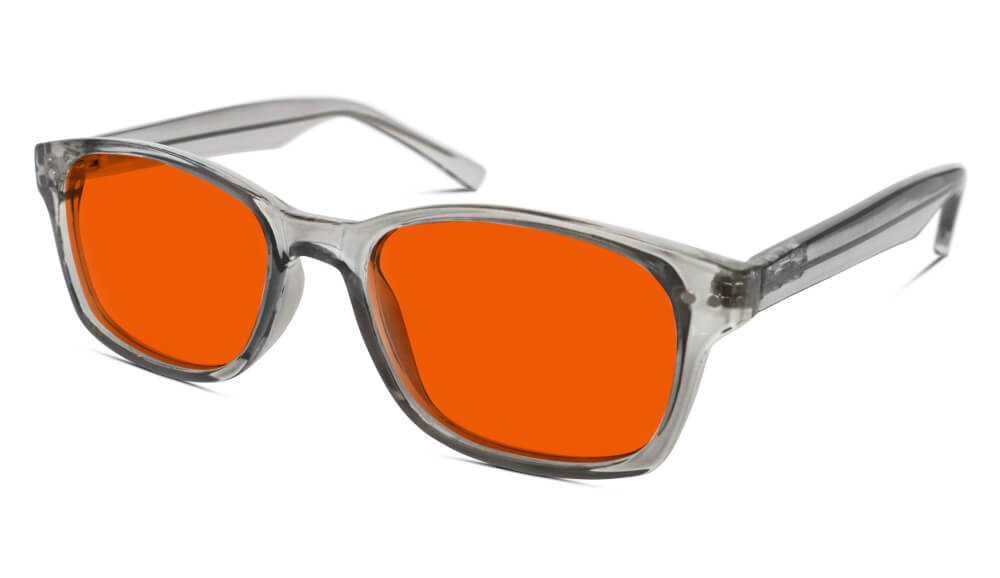
Amber and orange lenses designed specifically for nighttime use generally filter short-wavelength light more strongly.
Depending on the manufacturer and model, they may block nearly all relevant blue wavelengths while letting more longer-wavelength light through.
For many patients, I find amber lenses easier to wear because they preserve more familiar color perception than darker red lenses.
This is where I usually recommend starting.
Red lenses
Deep red nighttime lenses typically filter a broader range of visible light.
Beyond strong blue-light filtering, they can substantially reduce transmission of green wavelengths.
That may further reduce circadian light stimulation, especially in brightly lit evening environments.
However, lens color alone doesn’t guarantee performance. The actual spectral-transmission measurements matter.
Red lenses can be harder to get used to because they change how everything looks.
Why I Start Patients With Amber Lenses
When I introduce patients to nighttime light protection, I usually recommend starting with a quality pair of amber or orange glasses.
Why not immediately start with the strongest red lenses?
Because changing habits is part of the process.
If someone has spent years sitting under bright lights every evening, putting on dark red glasses at sunset can feel strange.
Colors look different. Watching television feels different. Even moving around the house can take some adjustment.
I want patients to understand the purpose of the intervention and develop a habit they can maintain.
I personally wore amber lenses for approximately six months before switching to red.
The transition worked well for me, but it isn’t a requirement for everyone.
I prefer to start with lenses that substantially filter circadian-relevant blue light, then decide whether broader filtering is appropriate.
For the nighttime glasses I recommend, I look closely at their filtering near 480 nm—not simply whether the manufacturer calls them amber or red.
The right pair provides the intended light protection and is one you’ll consistently wear.
How Can You Tell Whether Your Glasses Are Blocking Blue Light?
Here’s a simple demonstration I like to show patients.
Look at the image below without your glasses.
Then look at it again while wearing your blue-light-blocking lenses.
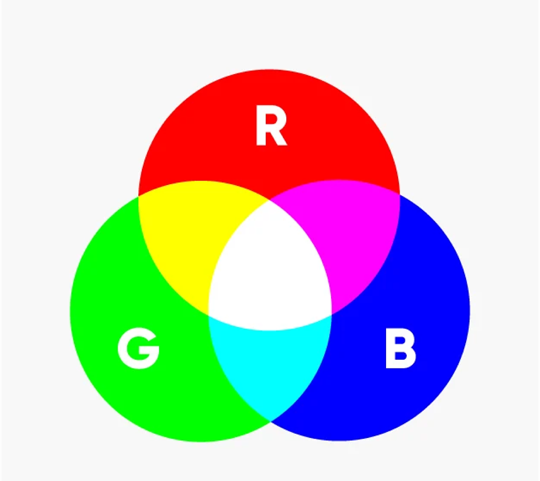
Demonstration: View the colors through your lenses; visual changes do not certify spectral blocking at 480 nm.
Notice what happens to the blue circle.
With lenses that strongly filter the blue light emitted by your particular screen, that circle should become very dark or may appear to disappear.
If it still looks bright blue, your glasses may be allowing more blue light through than you expected.
Now look at the green circle.
Stronger red lenses that filter green wavelengths may also darken it.
It’s a useful way to see that different lenses produce different results.
One important limitation: This is a visual demonstration, not a laboratory test. Screen technology and brightness vary, and the image cannot prove that glasses block 100% of light at 480 nm.
For that, we need measured spectral-transmission data for the specific lenses.
Still, it makes one point very clearly:
Just because two pairs of glasses are called blue-light blockers doesn’t mean they filter light the same way.
Which Blue-Light-Blocking Glasses Do I Personally Use?
Patients often ask which blue-light-blocking glasses I recommend.
I personally wear BlockBlueLight glasses, and my family uses them too.
I appreciate that the company offers different lenses designed for daytime and nighttime use, with published information about their filtering characteristics.
For evening use, I recommend choosing the right nighttime lenses rather than assuming every pair of blue-light-blocking glasses provides the same protection.
As I’ve explained throughout this article, what matters most is how effectively the specific lenses filter circadian-relevant wavelengths, particularly around 480 nm.
You can learn more at https://www.blockbluelight.com/.
Affiliate Disclosure: I have an affiliate relationship with BlockBlueLight and may receive compensation from qualifying purchases. My recommendation reflects my personal experience with the products, but you don’t need to buy this brand to follow the light-protection principles discussed in this article.
Are Glasses Enough?
This is where we need to look beyond the glasses themselves.
Imagine putting on an excellent pair of nighttime blue-light blockers while sitting beneath a room full of bright overhead lighting.
The glasses may substantially reduce certain wavelengths reaching your eyes.
But brightness, timing, and the rest of your environment still matter.
You can’t assume that wearing glasses makes every nighttime lighting environment equivalent to darkness.
That’s why I teach patients to think about their entire daily light schedule.
Get outside for natural daylight, especially in the morning.
As the sun sets, start reducing your exposure to artificial light.
Dim overhead lights, reduce unnecessary screen brightness, and use warmer, lower-intensity lighting in the evening.
If you need artificial light after sunset, appropriately selected nighttime glasses can provide an extra layer of protection.
Remember, sleep still requires an appropriate environment. Glasses don’t replace a dark bedroom.
The goal is to help your body clearly distinguish between day and night.
Do Blue-Light-Blocking Glasses Actually Improve Sleep?
Here’s an important distinction.
Strong evidence shows that evening light exposure can influence circadian timing and melatonin signaling.
Evidence that blue-light-blocking glasses consistently improve sleep outcomes is less clear.
Some clinical studies have reported improvements in measures such as sleep onset or perceived sleep quality, particularly in certain populations.
Other studies have found smaller or inconsistent benefits.
That doesn’t make the biological mechanism irrelevant.
It means reducing evening light exposure and successfully treating someone’s sleep problem aren’t necessarily the same.
A patient might have obstructive sleep apnea, significant nasal obstruction, chronic insomnia, restless legs, or another condition contributing to poor sleep.
Blue-light-blocking glasses won’t resolve those problems on their own.
I see nighttime light protection as one tool to support circadian biology—not a stand-alone treatment for every sleep disorder.
Why This Matters at Sleep Healthy PA
When someone tells me they aren’t sleeping well, I don’t want to look only at the number of hours they spend in bed.
I also want to understand what signals their body is receiving throughout the day.
Are they getting natural daylight?
What does their evening lighting look like?
Are they spending hours under bright artificial lights after sunset?
Do their nighttime routines support or interfere with the timing of their biological clock?
These questions don’t replace an airway evaluation or sleep testing when indicated.
They expand the conversation.
For someone with obstructive sleep apnea, a properly selected treatment such as an oral appliance may be necessary to manage the airway during sleep.
But we can also evaluate other factors that influence sleep and overall health.
An appliance addresses one part of the problem. Understanding your daily light environment addresses another.
That’s the foundational-health approach I want patients to understand.
The Bottom Line
You don’t need to become an expert in light physics to make meaningful changes.
But you should understand that not every pair of blue-light-blocking glasses is designed for the same purpose.
A clear computer lens, a quality amber nighttime lens, and a deep red lens may produce very different results.
If your goal is to reduce the artificial light signals that can interfere with normal nighttime melatonin production, choose glasses based on their actual filtering characteristics.
And don’t forget the bigger picture.
Light during the day. Less artificial light after sunset. Darkness when you sleep.
The goal isn’t simply to put on glasses before bed.
It’s to help your body recognize when the day is ending.
Common Questions
When should I start wearing blue-light-blocking glasses?
For patients following my evening light-protection protocol, I generally recommend putting on their nighttime lenses around sunset when they’ll be exposed to artificial light. Individual needs and schedules can vary.
Are amber glasses as effective as red glasses?
It depends on the exact lenses and what you’re trying to filter. High-quality amber lenses can strongly reduce blue light, while red lenses often filter more green light. That doesn’t mean everyone needs red lenses.
Do clear blue-light glasses protect melatonin?
Some reduce short-wavelength light, but many are not designed to provide strong nighttime circadian protection. Check their transmission near 480 nm rather than relying on the label.
Does My Phone’s Night Mode Replace Blue-Light-Blocking Glasses?
No.
Night Mode may make your screen look warmer, but it doesn’t reliably protect your nighttime melatonin signal.
In a controlled study, warming a screen without reducing brightness did not significantly change melatonin suppression across the tested Night Shift settings. A separate randomized study of 167 young adults found no overall sleep benefit from Night Shift.
Your phone can still expose your eyes to light that stimulates the circadian system.
Night Mode is not a substitute for reducing artificial light exposure after sunset. Appropriately selected nighttime lenses can also reduce short-wavelength light reaching your eyes.
Can blue-light-blocking glasses cure insomnia or sleep apnea?
No. They may help reduce evening light exposure, but they’re not established stand-alone treatments for insomnia or obstructive sleep apnea.
References and Further Reading
- Lights Should Support Circadian Rhythms: Evidence-Based Scientific Consensus. Frontiers in Photonics, 2023.
https://www.frontiersin.org/journals/photonics/articles/10.3389/fphot.2023.1272934/full
- Interventions to Reduce Short-Wavelength (“Blue”) Light Exposure at Night and Their Effects on Sleep: A Systematic Review and Meta-Analysis. Sleep Advances, 2020.
https://pmc.ncbi.nlm.nih.gov/articles/PMC10127364/
- Evening Wear of Blue-Blocking Glasses for Sleep and Mood Disorders: A Systematic Review. Chronobiology International, 2021.
https://pubmed.ncbi.nlm.nih.gov/34030534/
- Efficacy of Blue-Light Blocking Glasses on Actigraphic Sleep Outcomes: A Systematic Review and Meta-Analysis of Randomized Controlled Crossover Trials. Frontiers in Neurology, 2025.
https://pmc.ncbi.nlm.nih.gov/articles/PMC12668929/
- Does the iPad Night Shift Mode Reduce Melatonin Suppression? Lighting Research & Technology, online 2018; print 2019.
https://pmc.ncbi.nlm.nih.gov/articles/PMC6561503/
- Does iPhone Night Shift Mitigate Negative Effects of Smartphone Use on Sleep Outcomes in Emerging Adults? Sleep Health, 2021.
https://pubmed.ncbi.nlm.nih.gov/33867308/
This article provides general education and is not a substitute for individualized medical or dental evaluation.
Andrew Cohen, DMD, Diplomate ACSDD
Sleep Healthy PA
Jenkintown, Pennsylvania

